

Welcome to the Eastreasure Feng Shui Guide.
In a world that often feels chaotic and fast-paced, creating a sanctuary of peace and focus is no longer a luxury—it is a necessity. Feng Shui (Wind and Water) is the ancient Chinese art of placement. It is not merely superstition; it is the study of how energy, or Qi, flows through a space and affects the people within it. According to National Geographic, these principles have guided spatial arrangement for thousands of years to ensure harmony.
Whether you are looking to boost your career success, invite wealth, or simply sleep better at night, the arrangement of your environment plays a pivotal role.
In this comprehensive guide, we will explore the essential principles of a prosperous feng shui office layout, the critical rules of desk placement feng shui, the vitality of plants in feng shui, and the often-misunderstood taboos regarding feng shui and mirrors in bedroom.
Chapter 1: The Power of Position – Feng Shui Office Layout
Your office is your engine of wealth. It is where ideas are born, decisions are made, and abundance is generated. A poor layout can lead to stagnation, fatigue, and missed opportunities, while an optimized feng shui office layout can accelerate career growth and clarity.
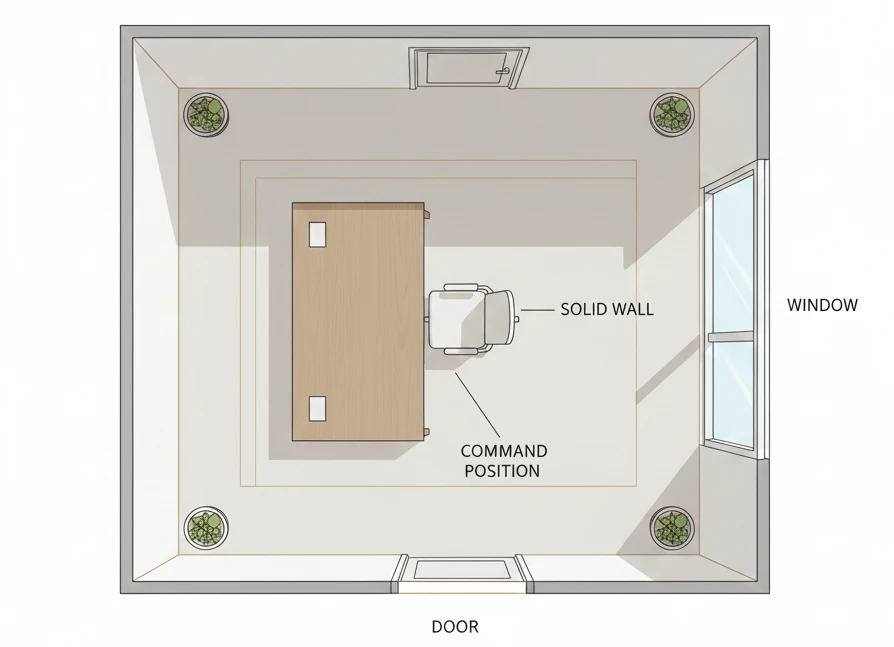
The Command Position
The most fundamental rule in any office is the “Command Position.” This governs where you sit in relation to the door.
- The Rule: You should always be able to see the door from your chair, but you should not be directly in line with it.
- The Why: Being in line with the door puts you in the path of rushing Qi, which can be draining. Having your back to the door leaves you vulnerable (symbolically “stabbed in the back”) and anxious.
- The Fix: If your office layout restricts you, place a mirror on your desk so you can see the reflection of the door behind you. For personalized advice on difficult layouts, you can <a href=”/pages/contact”>contact our experts</a>.
Decluttering for Clarity
Clutter is the enemy of Feng Shui. It represents stagnant energy and procrastination.
- Clean Desk Policy: At the end of every day, clear your desk. A clean slate in the morning invites new opportunities.
- Cable Management: Tangled wires represent tangled thoughts. Keep cords hidden to maintain mental clarity.
The Five Elements in the Office
To create a balanced feng shui office layout, you must incorporate the five elements. You can find artifacts representing these elements in our Shop Collection:
- Wood (Growth): Add a wooden desk or live plants.
- Fire (Recognition): Use proper lighting or red accents.
- Earth (Stability): Use ceramics or stone artifacts.
- Metal (Focus): Incorporate metal decor (like our Brass Pixiu).
- Water (Wisdom): Use black colors or fluid shapes (like our Obsidian Talismans).
Chapter 2: Mastering Desk Placement Feng Shui
Once the general layout is set, we must zoom in on the desk itself. Desk placement feng shui is critical because your desk represents your career.
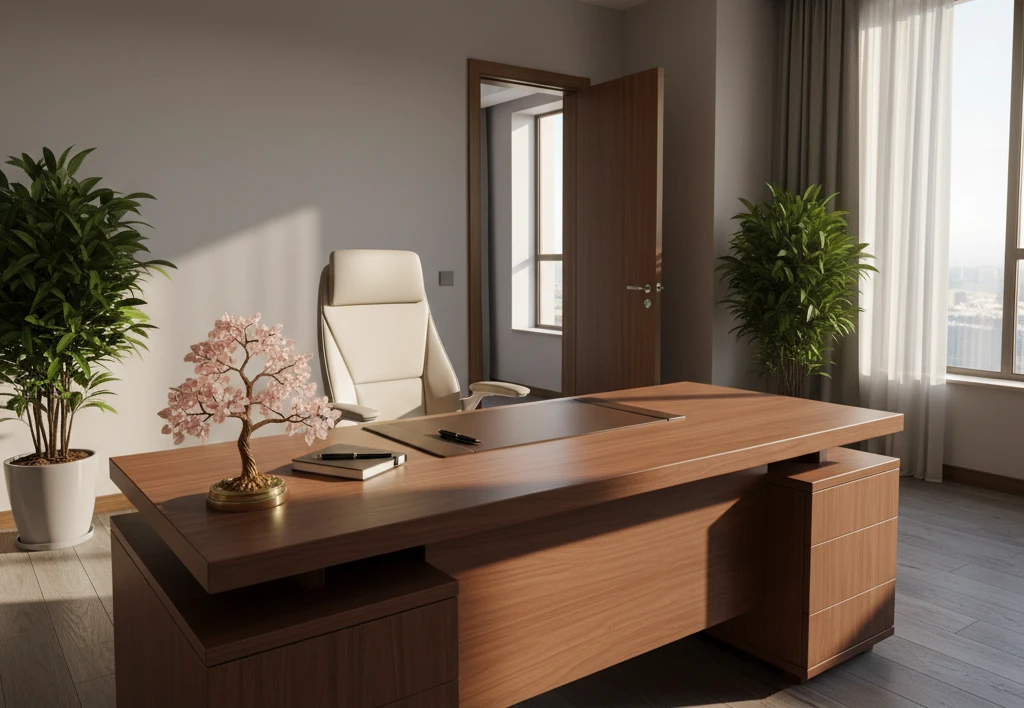
Where to Place Your Desk
- Diagonal to the Door: Ideally, place your desk in the corner diagonally opposite the door. This gives you the widest view of the room and maximum command.
- Solid Wall Behind: You need support. Always sit with a solid wall behind you. This represents strong backing from bosses and mentors.
- Avoid: Sitting with a window behind you. This lacks support and symbolizes energy leaking out. If you must, place a heavy cabinet or a strong Feng Shui Mountain painting behind you for stability.
- Open Space in Front: The area in front of your desk is your “Phoenix” space. Keep it open to allow foresight and vision for the future.
What to Put on Your Desk
The items on your desk influence specific energies:
- Top Left (Wealth Corner): Place a symbol of abundance here. A Feng Shui Crystal Tree (Citrine) or a Three-Legged Money Toad is perfect for inviting financial growth.
- Top Right (Relationship Corner): Place a pair of items here if you wish to improve business partnerships or client relations.
- Center (Health/Career): Keep this area clear for working.
Chapter 3: Cultivating Life – Plants in Feng Shui
Bringing nature indoors is one of the fastest ways to lift the vibration of a space. Plants in feng shui represent the Wood element, which symbolizes growth, expansion, and new beginnings. However, not all plants are created equal.
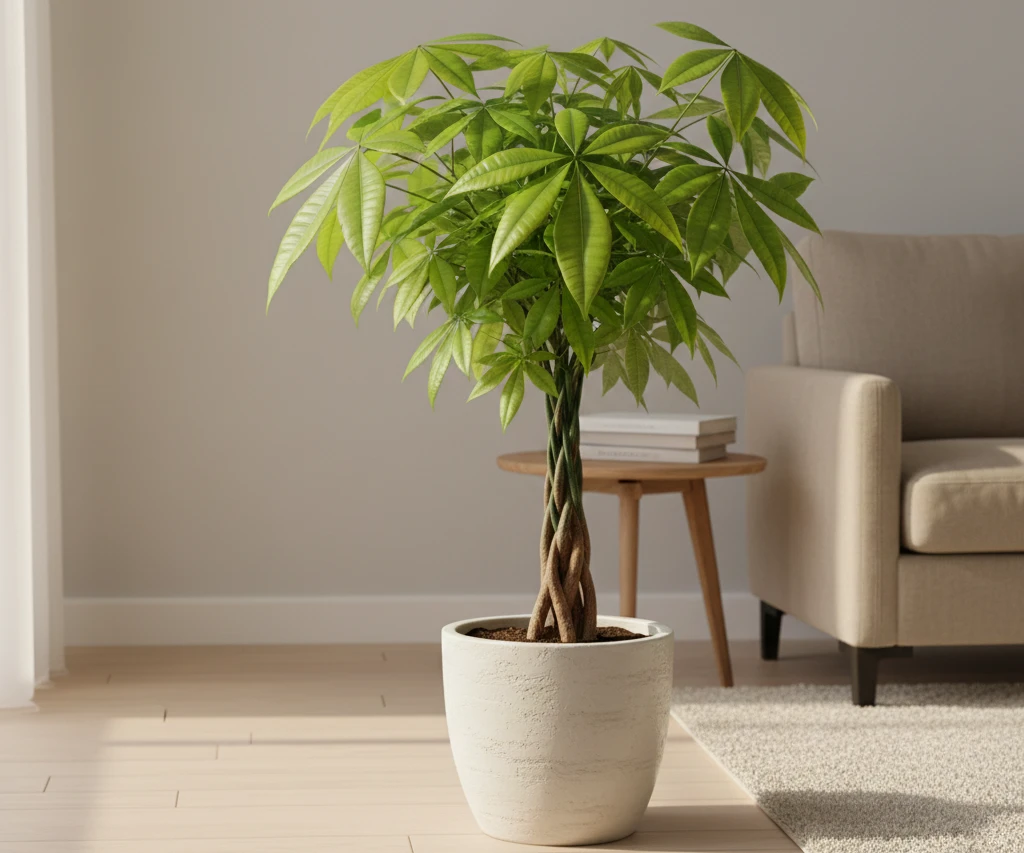
The Best Feng Shui Plants
- The Money Tree (Pachira Aquatica): Famous for attracting wealth. The braided trunk locks in fortune.
- Lucky Bamboo: Represents resilience and upward mobility. Ideally, keep 3 stalks for happiness or 8 stalks for wealth.
- Jade Plant (Crassula Ovata): With round, coin-like leaves, this succulently represents accumulated wealth.
- Peace Lily: Excellent for purifying air and energy. According to the famous NASA Clean Air Study, Peace Lilies are effective at removing common household toxins.
Plants to Avoid
- Cacti and Thorny Plants: Sharp spikes create “Sha Qi” (poison arrows). They create defensive, prickly energy that can lead to arguments or legal disputes.
- Dying or Sick Plants: A dying plant represents dying energy. Remove it immediately and replace it with a vibrant one.
Feng Shui Where to Place Plants
Knowing feng shui where to place plants is just as important as the plant itself.
- The Wealth Corner (Southeast): This is the ultimate spot for your Money Tree or Jade Plant. It activates financial luck.
- The Fame Area (South): Wood feeds Fire. Placing plants here boosts your reputation and recognition.
- The Health Area (East): Placing lush greenery here supports family health and vitality.
- Avoid the Bedroom: Generally, too many plants in the bedroom can be too “active” (Yang energy) and may interfere with sleep. One small plant is fine, but avoid a jungle.
Chapter 4: Rest and Reflection – Feng Shui and Mirrors in Bedroom
The bedroom is for two things: rest and romance. It is a Yin (passive) space. One of the most debated topics is feng shui and mirrors in bedroom.
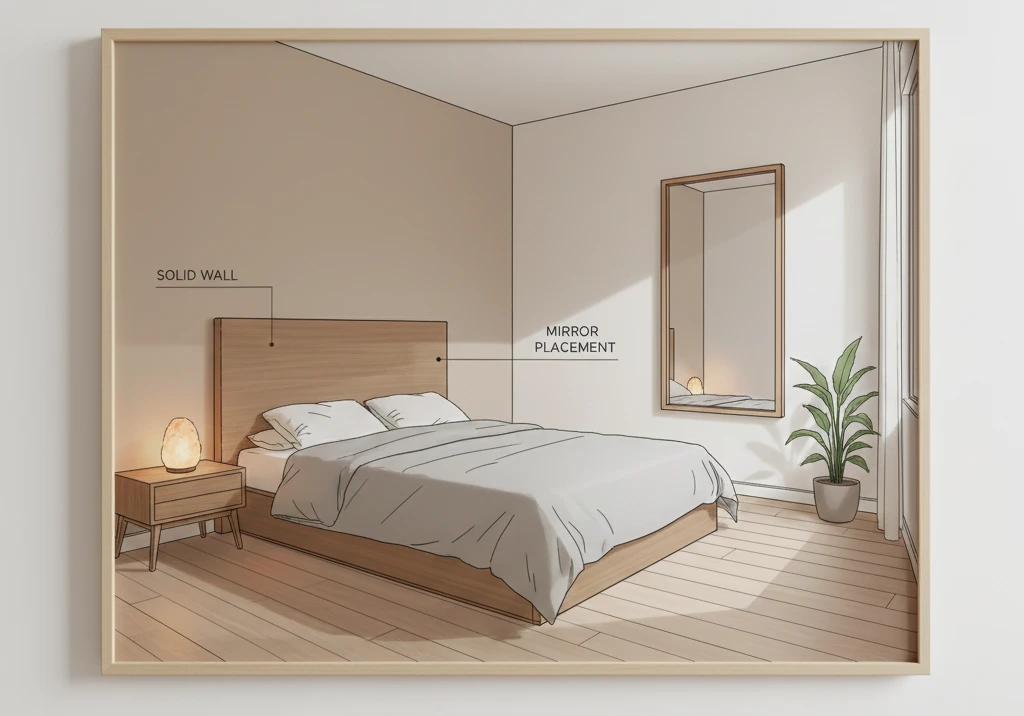
The Taboo of Mirrors
In traditional Feng Shui, mirrors are considered “energy accelerators.” They bounce Qi around the room.
- The Problem: When you sleep, your soul and energy field need to settle. A mirror facing the bed reflects your energy back at you, keeping you in an active state. This causes insomnia, restlessness, and even nightmares.
- The “Third Party”: Some traditions believe a mirror reflecting the couple’s bed invites a third party into the relationship, encouraging infidelity.
How to Fix It
If you have feng shui and mirrors in bedroom setups that violate these rules, here are the solutions:
- Move the Mirror: Position it so it does not reflect the bed directly.
- Cover It: If you have mirrored closet doors that cannot be moved, cover them with a curtain or fabric at night.
- Placement: The best place for a mirror is on the inside of a wardrobe door, so it is hidden when not in use.
Other Bedroom Tips
- Bed Position: Like the desk, place your bed in the command position (diagonal to the door).
- Under the Bed: Keep the space under your bed clear. Storing boxes, shoes, or old documents there blocks the flow of Qi and can cause subconscious stress.
- Protection: Hang a White Hetian Jade Amulet or a Wu Lou (Gourd) by your bedside to absorb sickness energy and promote deep, restorative sleep.
Chapter 5: Enhancing Your Space with Eastreasure Artifacts
Understanding the rules is the first step. The second is creating the remedy (or “Cure”). At Eastreasure, we curate authentic artifacts specifically designed to correct energetic imbalances and amplify positive flows.
For the Office (Career & Wealth)
- The Brass Pixiu: If your office layout is less than ideal, or you are facing a competitive environment, placing a Pixiu on your desk facing the door can protect your assets and devour negativity.
- The Wen Chang Pagoda: For those needing focus or academic success, this tower placed on the desk enhances mental clarity.
For the Home (Health & Harmony)
- The Wu Lou (Gourd): The ultimate symbol of health. Place one on your nightstand to protect against illness energy.
- Rose Quartz or Amethyst: Crystals that soften the energy in the bedroom, promoting harmony without the “active” chaos of mirrors.
Personal Protection
- Wearable Talismans: Sometimes, you cannot control your environment (like an open-plan office). In these cases, wearing a Cinnabar or Obsidian necklace creates a personal shield around your aura, protecting you from the bad Feng Shui of your surroundings.
Conclusion: Start Your Journey
Feng Shui is not about changing your entire house in one day. It is about making intentional adjustments. Start small. Move your desk. Buy a healthy plant. Cover that mirror facing your bed.
Remember, your environment is a reflection of your inner state. By harmonizing your outer world with feng shui office layout principles and mindful decor, you pave the way for inner peace and outer prosperity.
Explore our collection to find the perfect tools for your Feng Shui journey.